

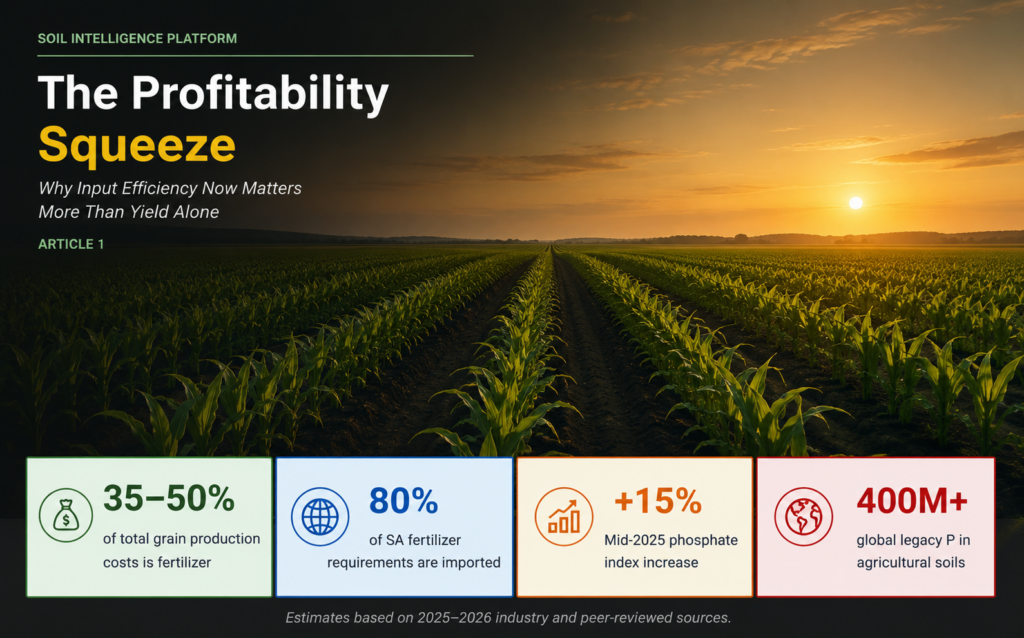
South African grain producers are entering one of the most economically challenging production periods in recent years. Fertilizer now commonly represents between 35% and 50% of total grain production costs, while diesel may contribute a further 12%–18% depending on tillage intensity and logistics requirements. At the same time, South Africa imports approximately 80% of its fertilizer requirements, leaving local agriculture heavily exposed to global geopolitics, shipping disruptions and volatile energy markets.
For many years, farming systems were built around yield maximisation because strong production diluted fixed costs. Under current conditions, however, the economics are changing. Rising fertilizer costs, increasing diesel prices, financing pressure and uncertain grain prices mean the highest-yielding hectare is not always the most profitable hectare. The focus is increasingly shifting away from input intensity and towards input efficiency.

This distinction is important because many farming systems may already contain large reserves of nutrients accumulated through decades of fertilizer application. Research globally now recognises that total nutrient content and plant-available nutrient content are not the same thing. Significant quantities of phosphorus, potassium and micronutrients may physically exist within soils while remaining chemically or biologically inaccessible to crops.
Globally, scientific interest is increasingly focused on nutrient-use efficiency and rhizosphere biology. Importantly, this should not be confused with simplistic “replace fertilizer” narratives. The real question is whether farming systems can improve access to nutrients already present within the soil profile while improving the return generated from every kilogram of fertilizer and every litre of diesel applied.
The emerging concept is not lower-input agriculture for ideological reasons. It is economically driven efficiency agronomy focused on improving nutrient accessibility, reducing waste and stabilising profitability under increasingly volatile production conditions.

One of the least discussed realities in agriculture is that many soils may already contain substantial nutrient reserves accumulated through decades of fertilizer application. However, much of this nutrient capital may not remain fully accessible to crops under current soil conditions.
Phosphorus is one of the clearest examples. Research suggests that crops often utilise only 15%–30% of applied phosphate fertilizer during the season of application, with the remainder becoming fixed within soil systems through interactions with calcium, iron and aluminium
compounds. Over years and decades, this can create large reserve phosphorus pools within agricultural soils.
This distinction between total nutrient content and plant-available nutrient content is critically important. A soil may contain substantial phosphorus reserves while still testing low in available phosphorus and showing strong crop responses to additional fertilizer applications. The issue is not always nutrient absence; it is often nutrient accessibility.
Potassium follows similar principles. Large quantities of potassium may exist within clay minerals, feldspar and mica structures, yet only a fraction remains readily exchangeable and plant-accessible during key crop growth periods. In many systems, crops are effectively growing above large nutrient reserves that are only partially available.
This creates an important economic concept: soils are not merely growing media; they are nutrient capital systems. Farmers have already invested billions of rand into phosphorus, potassium and broader fertility programmes over many decades. The challenge increasingly becomes how efficiently crops can access that existing nutrient capital.
Soil chemistry strongly governs this process. pH, cation exchange capacity, organic matter, mineralogy, moisture and microbial activity all influence nutrient availability. Phosphorus availability, for example, declines sharply under very acidic or highly alkaline conditions because phosphorus becomes increasingly fixed in less soluble forms.

This is why scientific interest is increasingly focused on nutrient mobilisation and nutrient-use efficiency. The objective is not fertilizer elimination. The objective is improving access to nutrients already present within farming systems and improving the efficiency of fertilizer investments already made.
Biological products have become one of the most debated areas in agriculture, largely because the market contains both credible science and exaggerated claims. However, there is now substantial peer-reviewed evidence showing that certain microorganisms can influence nutrient availability and nutrient-use efficiency under specific conditions.
Most of these interactions occur within the rhizosphere — the highly active zone surrounding plant roots where roots, microbes, minerals and soil chemistry interact continuously. Certain microorganisms produce organic acids, phosphatase enzymes, siderophores and chelating compounds capable of influencing nutrient solubility and plant uptake.

Phosphorus has become one of the primary targets for biological nutrient mobilisation because large portions of applied phosphate fertilizer become chemically fixed within the soil profile. A 2026 meta-analysis examining phosphate-solubilising bacteria reported increases in available soil phosphorus of approximately 86.8% relative to uninoculated controls. The same analysis also reported increases in available nitrogen of 64.9% and available potassium of 40.9%.

Importantly, the same research also showed that biological performance was strongly influenced by soil pH, organic matter, crop species and microbial strain selection. This is important because it demonstrates that biological performance is not universally predictable and that outcomes are highly dependent on environmental conditions.

Potassium-solubilising microorganisms are also receiving increasing attention. A 2026 meta-analysis covering more than 100 studies reported increases in available potassium of approximately 28.9%, root length increases of 29.5%, leaf area increases of 44.7% and average crop yield improvements of 23.4% under many conditions.

Micronutrient mobilisation is another important area of interest. In alkaline or calcareous soils, zinc and iron may become poorly available even when physically present within the soil profile. Certain microorganisms produce siderophores capable of binding and mobilising iron. Others alter rhizosphere pH or release chelating compounds that improve micronutrient accessibility.
Importantly, many biological responses may result not only from nutrient mobilisation itself, but also from improved root architecture, hormone production and rhizosphere stimulation. The most scientifically defensible way to view biological systems is therefore not as direct fertilizer replacements, but as nutrient-efficiency tools capable of improving system performance under certain conditions.
In Article 2, we will explore why biological products often fail under field conditions, examine the emerging concept of a “second green revolution” driven by biology and efficiency agronomy, and assess how future farming systems may improve access to existing soil nutrient reserves while reducing unnecessary input pressure and operational costs.
South African fertilizer and input cost pressure
Nutrient-use efficiency and soil nutrient reserves
Phosphorus fixation and nutrient reserves
Potassium reserve pools and soil mineral interactions
Phosphate-solubilising microorganisms
Rhizosphere biology and nutrient mobilisation
Iron and micronutrient mobilisation